

My first experience with a head-mounted display was with the Oculus Rift DK1 at an unpaid internship for a photogrammetry and motion capture studio around 2014. My project was to use Unity and some very early SDKs to be able to walk around a virtual museum as a digital twin of myself. I would bring my ASUS laptop over, with its Core 2 Duo CPU and very limited NVIDIA GT-something-M laptop GPU that I vaguely recall could only reliably handle up to DirectX 9, and I’d get to work writing C# scripts while occasionally velcro-strapping the bulky plastic box to my face. Everything about the situation was a tad suboptimal. Between driving my father’s old green Toyota Camry ’03 with worn out brake pads and the bulky Oculus headset instantly giving me headaches, I felt that a virtual museum sounded nice, but otherwise never wanted to put one of those things on my head ever again. I wrote off virtual reality as a mistake and declared that unless Nintendo or Apple decided to jump into the game, this was a niche product category for the smelliest of techies (I might’ve been a tech-addicted recluse myself, but I’ve always enjoyed a long hot shower, thank you very much). Probably not a fair assessment, but I didn’t feel compelled to take VR seriously.
Roughly ten years later, Apple released the Apple Vision Pro, and my stance on VR, now part of a bigger “Mixed Reality” or “XR” concept, needed an update. So naturally, I demoed the Apple Vision Pro within a couple of months of its release. When I visited the Apple Store to do the demo, the device looked smaller in person, and the materials were an appealing blend of fabric, metal, and glass. It almost felt like I had walked into a dealership to test drive a brand-new car. Unfortunately, they were unable to make demo lens corrections for me, but my eyesight isn’t terrible without corrective lenses (I have 20/50 vision and slight astigmatism), and I still got the impression that this was nothing like my experience with the Oculus Rift. I didn’t really care for the 3D dinosaurs (or many of the other demos for that matter), but the machine felt like something totally new. It felt new… but just as useless as the online reviews were pointing out. The Apple Silicon M2 processor (along with the special Apple R1 coprocessor) was impressive, and I immediately understood how to look and pinch at things, but it was tiring and dim compared to real life. Just because the windows were floating now didn’t mean I’d be more productive. I didn’t make a purchase, but I did ask if I could trade in my Apple Studio Display (to which they told me that the Apple Studio Display won’t be available for trade-in credit until a second generation is made).
Long story short, it’s late 2025, and I had yet to own or regularly use a head-mounted display, but XR and Spatial Computing were now on my radar.
Eyeing the Apple Vision Pro (M5) Refresh
So now it’s 2025, the Meta Quest 3 and Meta Ray-Ban have gotten a lot of attention, Valve has announced their Steam Frame headset to a very enthusiastic customer base, Google is pushing Android XR with Samsung’s Galaxy XR, and Apple has refreshed the Apple Vision Pro. Things happen so quickly in tech, so I started to feel like if I blinked, I might just miss the moment spatial computing becomes a lucrative frontier and the opportunity to get in early (I didn’t do that internship 10 years ago for nothing!). I headed over to the Apple Store for another demo, curious to see if XR was really going to be a viable path forward. I showed up early to my appointment, but unfortunately, they again couldn’t get me corrective lenses for the demo. I told the specialist helping me that I’d be less interested in the guided tour, and more interested to see what visionOS 26 could do. She was very helpful and friendly in letting me just use the device however I wanted to, and reached out to her manager (who owned an Apple Vision Pro) for my more specific questions. At this point, I was looking for a development kit, and my options were vast. Despite not having corrective lenses, I could tell things were slightly better. The radius of the foveated rendering was bigger, the refresh rate was higher, and a simple hand gesture replaced having to look up to access the Home Screen. It was a good experience, I didn’t get any headaches or motion sickness, the new dual-band strap was much more comfortable, and I was left more curious than ever about spatial computing.
$3,500 was still too steep though for a development kit. Additionally, prescription lenses are $150, and other inputs methods (e.g., controllers) would be another $100 or so, and the developer strap (if needed) would be $300. Though, the real kicker was that if I wanted to use Unity, it would cost $200/mo for the ability to build for Apple Vision Pro. The other headsets conform to OpenXR and wouldn’t cost extra for Unity or other SDKs, so I found a Black Friday deal for the PS VR2 and a PC adapter, and figured that would be enough. Sadly, Horizon Call of the Mountain was a beautiful experience, but the PS VR2’s fresnel lenses left me disoriented within 15 to 20 minutes. I had to lie down for a few hours to let it pass, but I couldn’t help but try it again. I triple checked my fit and played around some more, but again, it just made me sick within 20 minutes. I might’ve won the fight with a mechanical dinosaur (why is it always dinosaurs?), but I otherwise failed the quest to find an inexpensive development kit.
My options were now the Meta Quest 3, Samsung Galaxy XR, possibly waiting for the Steam Frame, and the Apple Vision Pro. I remembered my demo and Apple’s holiday return policy, and decided to get the Apple Vision Pro (M5).
The Big Decision
And so I decided… I can demo the unit for a few weeks, and if things don’t work out, I can return it, like so many other people have done.
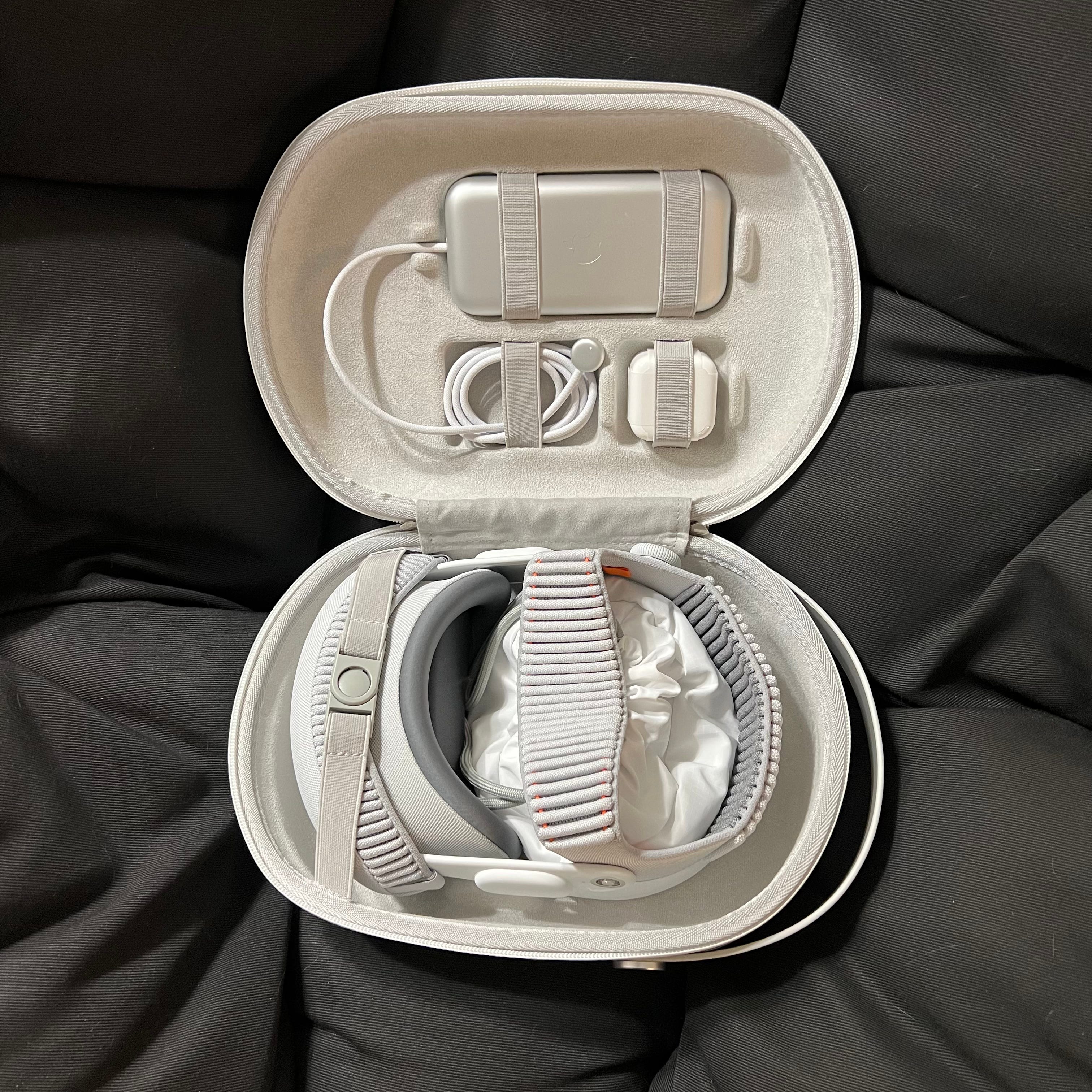
I placed my order online and picked up my unit. For anyone else picking one up this holiday season, just be sure to double-check the fit at the store. Maybe the lighting was poor at home, but the fitting test I did with my iPhone sized me a little too large. Had I not double-checked at the store, I probably wouldn’t have noticed and assumed the device was meant to fit that way. The prescription lenses will take another week to arrive.
Spatial computing could be having a moment, and it could be a breath of fresh air from several years of heavy focus on AI. XR could be an exciting frontier in 2026, and something to work on that isn’t threatening to replace us. Of course, there are still dystopian possibilities alongside idealistic possibilities, so I’m writing this with cautious optimism. I want to try it all, and see where we’re headed, even if the verdict is “not headed this way at all”.